Brought to you by Arthur
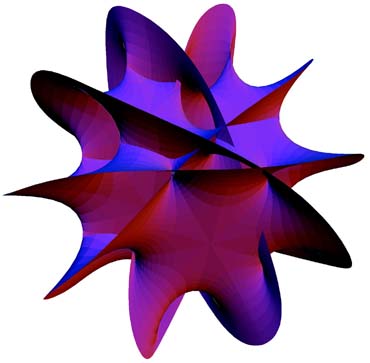
A computer-generated rendering of a possible six-dimensional geometry similar to those studied by UW-Madison physicist Gary Shiu.
Image: courtesy Andrew J. Hanson, Indiana University
Image: courtesy Andrew J. Hanson, Indiana University

13 comments:
I really liked this video. It explained dimensions, then 2D, than 3D than how there could be 4D worlds out there, but we don't know. My favorite part about this video is the humor they put into it, such as when they said 'and this blows his little square mind' and they made a little poof come out of his brain. In conclusion, this video was very detailed and descriptive.
I liked this video. It had good animation and used humor well, but was also very educational. I thought the way they explained dimensions, by expanding 1 way, then another, and another, was simple and relatively easy to understand. I could see some people saying that the 4th dimension is just a theoretical concept, because in the animation when you extend a cube to a hypercube, even though it meets the definition of being perpendicular to a 3D sheep it just looks like a more complicated 3D shape. Like the video says, it would be really hard to imagine what a 4D shape would actually look like. I found it interesting that all dimensions are perpendicular to each other.
.
This was a really interesting video! I have, time and time again, tried to imagine what a 4D object would look like, and fail each time. It was so cool to see them actually give a guess at what a so-called "hypercube" may look like, and when they first showed it as a line drawing, it wasn't even there long enough for me to comprehend it, but I soon saw it easier when they filled in the planes. However, I disagree that that is what it would look like to us. To me, it just resembled a cube inside a cube with the edges closing it in. I think that to the human eye, a 4D object might look like a sphere growing and shrinking if it passed through the 3rd dimension, because to the square, a sphere resembled a circle growing and shrinking. Also, when they were explaining 2D objects, they mentioned that a piece of paper was 2D, which is incorrect. Every item we see in our world visibly today is 3D and has some kind of height. I recall hearing a while ago that an average-sized piece of paper is somewhere around 1 million atoms tall (Please forgive me if I'm wrong). The shaped from "Flatland" shown in the video, if you looked closely, had tiny heights as well. I think that the real truth about a 2D shape would be that it would be invisible or nonexistent when viewing it from the side. Lastly, I thought it was cool how they explained 2D vision. Then I thought, if 2D shapes see a 1D line, than are we humans seeing things in 2D right now? And if so, what would it be like to see in 3D? Overall, although I had a few disagreements, this video was really cool and made me think more about dimensions.
I find this video very interesting! It is cool how it explains the properties of dimensions 1-4 and what a sphere would look like to a square. Also, it seems hypocritical that we say, "Though two-dimensional beings don't believe in the third dimension which actually exists, we three-dimensional people are exempt and there is no higher dimension than us." Isn't that strange? We are thinking in the same mind-frame as the theoretical two-dimensional beings, which we shouldn't because we should learn from "Flatland" and the video. It is the same with the sphere from the video. He helps the square understand the 3rd dimension, but he does not understand the 4th or 5th.
I think that the video was really cool. When I think of 2D I think of a piece of paper. Only to remind myself that paper is in fact 3D. I can't picture, or really understand a 2D world. This is the same for 4D. If I try to imagine a pillow in 4D I think of expanding more parallel lines. Only to remind myself that if it did have more parallel lines like I imagine is, it would still be 3D. This is the same for 1D, or 5D, and everything beyond. I guess this is how it will stay. With life on earth never being exposed to anything other then 3D, but I bet that somewhere in space there is a world where there is 2D or 4D, and every other D that you could imagine. And maybe one day astronauts will be able to fly to a planet like this. Overall I give this article a 10 out of 10.
It's very cool how they link everything together to make it into a pattern. I thought it was very cool overall and generally there isn't a lot for me to say about it except what I liked and what it taught me. It taught me not just about how tesseracts work, but how sometimes answers are right in front of us. I thought this was an amazing video with a lot of thought and a touch of creativity.
I thought this video gave a really good visual on how a four dimensional object would look, entering a three dimensional world. If I were just told how it would look, then it would seem hard to imagine, but because of the good cartoon, it was easier to see. I do recommend Flatland, the movie to anyone who finds this subjet interesting, like myself. The one part that was clarified in the video more so than in the movie, was how 2 dimensional objects would see other shapes in the second dimension. The only part that was a little off, which I still do not understand, is how they can see each other, when they are all two dimensional, or infinitely thin. Another part, which I did not understand either, is how you could have the fourth pair of perpendicular lines. Like the narrator said in the video, it is hard to imagine other dimensions, mainly because we have not seen them. Even though I am still slightly confused, I would give this article a nine out of ten, mainly because while it did not explain everything, it did explain some things.
I thought that this was a very interesting video. It was good that they explained what a 4D shape would look like. I liked how it showed us what a 3D object would look like in a 2D world. It was interesting how we would see things if we lived in a 2D world. I don't think I could take just seeing colors. The best part of this video was that they said that when he was raised he could see the insides of his friends. The part that could have been better was that the music was terrible. If they put in better music, it would have been fantastic. Overall this article was a 7 out of 10.
I'm not going to lie. This blew my mind. This video really actually gave me a headache trying to think about what a four dimensional object would look like. I think, how could there be another perpendicular line? But that's probably how flatlanders felt. Like Will said, it's actually a matter of being a hypocrite. I wonder what it would look like if there was a fourth perpendicular line. There could be a fourth or fifth perpendicular line, but Humans don't know how to envision that. Also, because 2D life forms see in 1D, does that mean us Humans see in 2D? I believe it does. I wonder how it would look to see in 3D, and 4D, and 11D, if this is true. This was my favorite part, when the narrator explains how the flatlanders see in the first dimension. I don't know how I'd be able to see in that though... It makes sense, but it's a bit hard. If you try to imagine a 4D shape, usually all you get is a more complicated 3D shape. This make me think about what could be out there in space. There are probably four dimensional worlds, hidden to us forever, by the nature of our perception.
This video was very interesting and made me think about the world that we live in more. We see everything in 3 dimensions, but there might be more dimensions out there that we can't see. For example in string theory, there is not supposed to be less than 10 dimensions. If there are extra dimensions that we experience yet cannot see, they are probably less than 1 mm, so small that we missed them when we searched for them.
I found this video really amazing. When the video started, I found myself speculative about whether this would be a childish video or an informative video. In this case, the animation helped a lot, giving me a picture of how the whole thing worked. I have always discussed with my friends what life would be like if it was 2D, and now I see how it works: we have trouble comprehending because we were not built for it. Is everything in our world 3D? I do wish it was reworked a little bit more. I was confused about 4 dimensions until the end, when he mentioned increasing everything by an inch. This cleared everything up for me. I would like to know about the fifth dimension, though. For those of us who read A Wrinkle in Time, we know what the tesseract is. No body has every talked about 5D, though. I would also like to know: why are 4D tesseracts depicted as moving into itself and then back? Here is a link as to what 5D looks like:
http://upload.wikimedia.org/wikipedia/en/5/5b/Dice_analogy-_5_dimensions.svg
As an additional note, I read that abstract 5D occurs a lot in mathematics; I am looking forward to exploring that, along with reading the book Frontland
This video was really fascinating. I love watching TED Talks like these because they're fun and educational at the same time. I liked that the video showed what a 2D world would look like because it's just impossible for me to imagine anything like that, since we are only exposed to the 3D world. I also find it hard to picture a 4D world. Many teachers show their students a tesseract, but I still can't really visualize somewhere or something that is 4 dimensional. So when the video showed the 4D hypercube in detail, I was able to understand more of what a 4D world would look like. Also, I watched Flatland in math class one time, and I really enjoyed learning about different dimensions and shapes. I would recommend it to those who are interested in this subject. Now that we have an idea of what a 4D world would be like, I wonder what a 5D world is like. I am very inspired to find out more about this subject. Overall, I give this video 5 out of 5 stars.
Post a Comment